
The Annual Lawn Care Checklist (Month by Month)
Quick Answer
Cool-season and warm-season lawns follow near-opposite calendars. Cool-season grasses take their heaviest feeding and all seeding in autumn, with pre-emergent in early spring. Warm-season grasses are fed only once fully green in late spring, through summer, and get no nitrogen at all in autumn. Identify your grass type first — then follow one track, not both.
At a glance
- Peak window
- Cool-season: early September — feeding, seeding, aerating and overseeding all land here. Warm-season: early May through mid-August, once the lawn has fully greened up.
- Acceptable window
- Cool-season seeding stretches to early October, and a light feeding works in April. Warm-season pre-emergent runs mid-February to mid-March depending on how far inland you are.
- Too late once
- Cool-season: soluble nitrogen after about 1 May, and seeding after mid-October. Warm-season: any nitrogen from September onward, which costs you winter hardiness.
- Varies by
- Grass type first, then latitude. The cool-season dates here are written for central Missouri and the warm-season dates for South Carolina; both shift by two weeks or more within their own states.
- Watch instead of the date
- Soil temperature for pre-emergent, full green-up before feeding warm-season grass, and first frost for the final potash application.
- Skip entirely if
- The lawn is more than half weeds, holds standing water, or fails in the same spot every year. A calendar maintains a sound lawn; it cannot repair a broken one.
Almost every lawn calendar online fails in the same way: it gives one set of months for “lawns,” as though a Kentucky bluegrass lawn in Missouri and a bermudagrass lawn in South Carolina want the same thing in September. They want opposite things. One is receiving its most important feeding of the year. The other must not receive nitrogen at all.
This checklist runs the two tracks side by side, month by month, with the specific rates and thresholds behind each task.
How to Use This Calendar
Shot: Wall calendar hanging in a garage beside lawn tools, with dates marked.
Alt text: A marked-up wall calendar in a garage next to lawn care equipment.
- Identify your grass type first. Nothing below is safe to follow without it. Use our identification guide if you are unsure.
- Follow one track only. Cool-season if you have fescue, Kentucky bluegrass or ryegrass. Warm-season if you have bermudagrass, zoysia, centipede or St. Augustine.
- Treat dates as approximate.The cool-season timings here follow Missouri Extension’s calendar for central Missouri; the warm-season timings follow Clemson’s bermudagrass programme for South Carolina. Both publications warn their own dates shift by two weeks or more within a single state.
- Watch the weather, not the date. Green-up, first frost and soil temperature drive most of these tasks. A warm spring moves everything forward.
In the transition zone, pick a lane
The Year at a Glance
Shot: Four-panel seasonal comparison of the same lawn through spring, summer, autumn and winter.
Alt text: One lawn photographed across all four seasons showing changing condition.
| Month | Cool-season priority | Warm-season priority |
|---|---|---|
| January | Nothing active. Plan and service equipment. | Dormant. Water only if 3-4 weeks without rain. |
| February | Nothing active. | Pre-emergent, coastal and central areas. |
| March | Broadleaf weeds, remove old growth, soil test. | Pre-emergent, cooler inland areas. Mow low before green-up. |
| April | Light feeding. Crabgrass pre-emergent by mid-month. Start mowing. | Green-up begins. Aerate and dethatch after frost risk passes. |
| May | Stop soluble nitrogen after the 1st. Post-emergent weeds. | First feeding once fully green. Replant bare areas. |
| June | Begin watering. Raise mowing height. | Second feeding, high potassium. Water deeply. |
| July | Water ~1 in/week. Scout for grubs. | Insecticide for young grubs and mole crickets if needed. |
| August | Prepare seedbed. Buy seed. Soil test. | Final nitrogen before the 15th. |
| September | The main event: feed, seed, aerate, overseed. | No nitrogen. Pre-emergent for winter weeds. Fungicide. |
| October | Second feeding. Lime if the test calls for it. | Potash before first frost. Preventative fungicide if needed. |
| November | Final mow. Keep leaves off. Moist not wet soil. | Raise mowing height as nights cool. Dormancy begins. |
| December | Service the mower. | Dormant. Monitor for winter desiccation. |
January - March
Shot: Dormant tan-coloured lawn in late winter with bare trees in the background.
Alt text: A dormant lawn in late winter before spring green-up.
Cool-season
- January - February: nothing to do outside. Service the mower and sharpen or replace the blade now — nobody is queuing at the shop, and it is done before the first cut rather than in July.
- March: apply broadleaf herbicide for perennial and winter annual weeds missed in autumn.
- Overseed thin spots if you missed the autumn window — second best, not equivalent.
- Before growth starts, power rake or mow to remove excess old growth. This also speeds soil warming and green-up.
- Soil test if you have not done one recently, so results are back before April feeding.
Warm-season
- Pre-emergent is the key task. Roughly mid-February in coastal and central areas, mid-March further inland, with a second application 8 to 10 weeks later for season-long control.
- Track soil temperature rather than the date. Local extension services and several weather sites publish it, and it is a far better trigger than a calendar square.
- Mow slightly lower than summer height — around 1 inch — just before green-up, bagging or raking off dead winter material. Do not scalp.
- No nitrogen yet. Feeding before full green-up risks new growth being burned by a late frost.
- Soil test now. Bermudagrass grows best around pH 6.0 to 6.5.
- Water during dormancy only if three to four weeks pass without measurable rain — winter desiccation is a real risk in dry winters.
- If grubs were a problem previously, cut a square-foot flap and count. More than six per square foot warrants treatment.
Cultivation breaks a pre-emergent barrier
April - June
Shot: Spring lawn being mown for the first time of the season, fresh green growth.
Alt text: First spring mowing of a lawn as active growth resumes.
Cool-season
- April: optional light feeding of 0.5 to 1 lb nitrogen per 1,000 sq ft, preferably slow-release.
- Apply crabgrass preventer by around April 15 in central Missouri — earlier further south.
- Start mowing at the recommended height. Aerate now only if thatch is heavy or soil is compacted.
- May: stop applying soluble nitrogen after about May 1. Late spring nitrogen encourages foliar disease and soft growth that suffers in summer.
- Post-emergent broadleaf control for summer weeds; begin crabgrass, goosegrass or nutsedge control late in the month if needed.
- June: begin watering as needed, deeply and infrequently. Raise mowing height by half an inch to an inch if the stand is thin — roughly 2.5 to 3 inches reduces scalping.
Warm-season
- April: once frost risk has passed, aerate and dethatch if needed. Dethatch only above half an inch of thatch.
- Early May, after full green-up: the first feeding — 0.5 to 1 lb nitrogen per 1,000 sq ft depending on soil type.
- Start mowing around 1.25 to 1.5 inches and lower gradually over several cuts, backing off a step if the lawn starts to look thin or scalped.
- May is the month to replant bare areas, using sod, plugs or sprigs.
- June: second feeding of 0.5 to 1 lb nitrogen, using a high-potassium product such as a 15-0-15.
- Water when the whole lawn looks dry — apply three quarters to 1 inch the following morning.
The footprint test tells you when to water
July - August
Shot: Sprinkler watering a lawn in bright summer light with heat haze.
Alt text: Summer irrigation of an established lawn during peak heat.
Cool-season
- July: irrigate about 1 inch per week including rainfall. In hot, humid conditions water between roughly 6 and 10am to reduce disease.
- Irrigate two to three times a week as absorption allows — not daily.
- Scout for white grubs in brown areas. If turf peels up easily and you count 5 to 10 grubs per square foot, treat, then irrigate thoroughly to move product into the root zone.
- Mow frequently, avoiding the hottest part of the day. Do not fertilize.
- Measure your sprinkler output once with straight-sided cans and you never guess again. Most established lawn soils absorb well under half an inch per hour, so a sprinkler usually applies water faster than the ground can take it.
- August: this is preparation month. Prepare the seedbed, buy seed and fertilizer, and soil test if unsure of fertility. Buying seed now rather than in September means better selection and no choosing under time pressure inside a narrow window.
- For a full renovation, apply glyphosate around mid-month. If killing bermudagrass, apply on 1 August and again a month later.
- Soak dormant lawns in the last week to trigger autumn growth.
Warm-season
- July: peak growth. Mow regularly with a sharp blade — monthly sharpening is reasonable at this pace.
- If mole crickets or grubs were a problem earlier, mid-July is the window to treat the young nymphs, which is far more effective than treating mature insects.
- Do not apply herbicides above 90°F, and avoid mowing for three days before or two days after any application.
- Before August 15: the final nitrogen application of the year, again 0.5 to 1 lb per 1,000 sq ft with high potassium.
- Potassium matters increasingly late in the season — it supports disease resistance and cold hardiness.
September - October
Shot: Overseeding an established lawn with a broadcast spreader in autumn light.
Alt text: Autumn overseeding of an established cool-season lawn.
This is where the two calendars diverge most sharply. For cool-season lawns it is the most important period of the year. For warm-season lawns it is the period where restraint matters most.
Cool-season — the main event
- September is the most important time to fertilize — 1 to 1.5 lb nitrogen per 1,000 sq ft.
- Seed or sod new lawns early in the month and keep the soil moist.
- Aerate where compaction warrants it. Early autumn is the preferred window.
- Dethatch if the layer exceeds half an inch. Rake, kill weed patches, overseed thin spots.
- Late September is the best time for broadleaf herbicides, especially on perennial weeds moving resources to their roots.
- October: mow at normal height until growth stops. Apply lime only if the soil test calls for it.
- Feed moderately once cool days have slowed leaf growth — around 50°F. Nutrients now build roots rather than top growth.
Warm-season — stop feeding
- No nitrogen from September onward. Late nitrogen pushes tender growth into frost and reduces winter hardiness.
- Potash is the exception: about 1 lb of K₂O per 1,000 sq ft, four to six weeks before the first expected frost.
- Apply pre-emergent in September, with a second application 8 to 10 weeks later, for winter annual weeds.
- Autumn is critical for large patch disease. Where it recurs annually, preventative fungicide from early October is worth considering, because turf weakened now recovers slowly in spring.
- Continue mowing at normal height until nights fall below 70°F, then raise slightly so the turf enters dormancy with more leaf surface.
Do not do everything in the same week
November - December
Shot: Autumn leaves being cleared from a lawn with a rake, late season light.
Alt text: Clearing fallen leaves from a lawn in late autumn.
Cool-season
- Mow at regular height until growth stops. Do not raise it dramatically for winter.
- Keep leaves from packing down and smothering the grass.
- A moderate late feeding is used efficiently — soluble nitrogen works well at this point in the year.
- Go into winter with soil moist but not wet.
- Recondition the mower: clean oil, empty fuel tank, blade sharpened ready for spring.
- Use soluble fertilizer or calcium chloride rather than rock salt for winter ice near turf.
Warm-season
- The lawn goes dormant and turns tan. This is normal, not death.
- Water only to prevent desiccation — particularly when warm bright days are followed by a hard freeze.
- Winter broadleaf weeds can be treated as needed, but bermudagrass is sensitive to some herbicides, so follow label rates carefully.
- Do not burn off dormant bermudagrass to clear debris. It risks turf injury and is a fire hazard.
If You Only Do Five Things
Shot: Close-up of a lawn spreader being calibrated with fertilizer granules visible in the hopper.
Alt text: Calibrating a fertilizer spreader before an application.
| Priority | Cool-season | Warm-season |
|---|---|---|
| 1 | September feeding — 1 to 1.5 lb N/1,000 sq ft | First feeding in early May, only after full green-up |
| 2 | Seed in early September, not spring | Late-winter pre-emergent, plus a second 8-10 weeks later |
| 3 | Crabgrass pre-emergent in early spring | Final nitrogen before 15 August, then stop |
| 4 | Mow high all season with a sharp blade | Potash 4-6 weeks before first frost |
| 5 | Water ~1 in/week, early morning, never daily | Mow high enough to avoid scalping, raise under stress |
Annual Nitrogen Targets
Shot: Fertilizer bag label close-up showing the N-P-K analysis numbers.
Alt text: Close-up of a fertilizer bag showing the N-P-K analysis.
Fertilizer programmes are built around nitrogen. These are yearly totals, split across the applications in the calendar above — individual applications should generally stay at or below 1 lb per 1,000 sq ft.
| Grass | Total lb N per 1,000 sq ft per year | When |
|---|---|---|
| Common Kentucky bluegrass | 2 - 3 | April, September, October |
| Higher-quality Kentucky bluegrass | 4 - 5 | April, September, October, November |
| Red fescue | 2 | April, September, October |
| Tall fescue or ryegrass | 3 - 4 | April, September, October |
| Bermudagrass | 2 - 4 | Early May, June/July, before 15 August |
Use the higher end on sandy soils and the lower end on clay. Our fertilizer calculator converts a nitrogen target into an actual bag weight, and the feeding schedule guide covers product selection.
Timing Errors That Cost You a Season
Shot: Patchy winter-damaged lawn showing frost injury on new spring growth.
Alt text: Frost-damaged new growth on a lawn fertilized too early in spring.
These are the mistakes specific to when rather than how. Each one is difficult or impossible to correct inside the same year.
| The error | What it costs | Do this instead |
|---|---|---|
| Running a cool-season calendar on a warm-season lawn | The whole year — feeding and stopping at opposite times | Identify the grass type, then follow one track only |
| Feeding warm-season grass before full green-up | New growth burned off by a late frost | Wait for full green-up, even if that is mid-May inland |
| Nitrogen on warm-season lawns after August | Reduced winter hardiness; tender growth into frost | Final nitrogen before 15 August, then potash only |
| Soluble nitrogen on cool-season lawns after early May | Foliar disease and soft growth that fails in summer | Shift the emphasis to the September and autumn feedings |
| Seeding cool-season grass in spring | Crabgrass competition plus summer stress on seedlings | Prepare in August, seed early September |
| Aerating or dethatching after a pre-emergent | Holes punched straight through the herbicide barrier | Cultivate just before the next application is due |
| Doing every September job in one weekend | Compounded stress on turf you are trying to thicken | Spread across two or three weekends; seed and feed first |
Frequently Asked Questions
Start From Where You Are in the Year
You are unlikely to be reading this in January. Pick up the calendar at today's date rather than waiting for a tidy starting point.
- Confirm your grass type with our identification guide. Do not skip this — the tracks conflict.
- Find the current month in the year-at-a-glance table and do what is listed for your track.
- Check what the next dated task is, and put it in your calendar now rather than trusting yourself to notice.
- If you have not tested your soil in the last few years, do that regardless of month — results take weeks and everything fertility-related waits on them.
- Set an annual nitrogen target from the table above and split it across the applications for your track.
- If the lawn has deeper problems than the calendar addresses, run the full lawn assessment first — a calendar cannot fix compaction, shade or grading.
This calendar assumes a fundamentally sound lawn
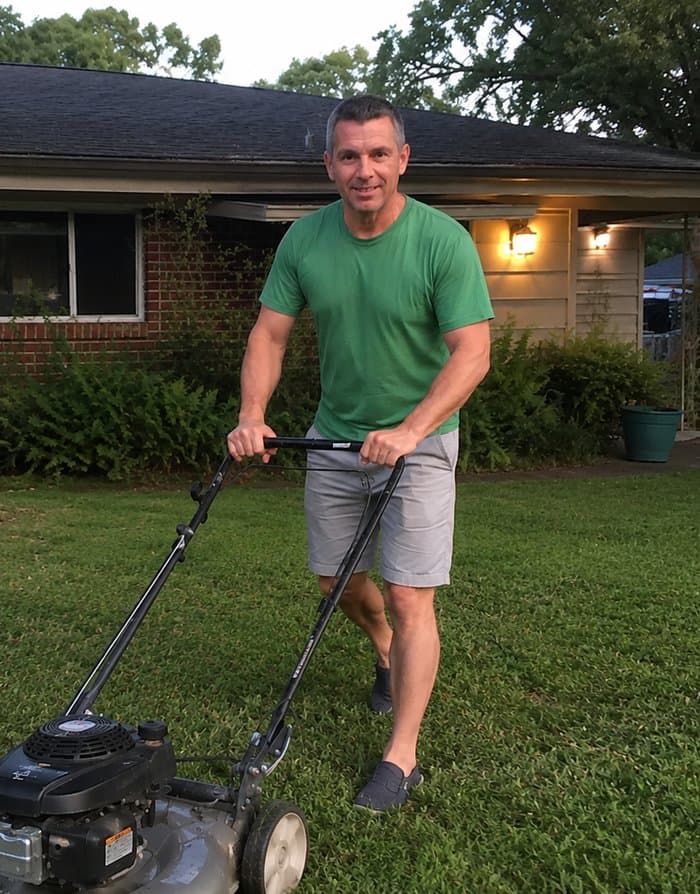
About the Author
Jack is a lawn care researcher and former landscaping crew lead with 20+ years working transition-zone turf. He writes every guide here from university extension publications and turfgrass research rather than product marketing — after learning the hard way that most of what gets passed around on job sites is backwards.
Have a question or topic suggestion? Get in touch.
Sources and further reading
- University of Missouri Extension — Cool-Season Grasses: Lawn Maintenance Calendar (G6705) (the cool-season month-by-month schedule, annual nitrogen totals by species, mowing heights, watering and aeration timing)
- Clemson Cooperative Extension — Bermudagrass Yearly Maintenance Program (HGIC 1216) (the warm-season schedule, pre-emergent timing, seasonal nitrogen and potash rates, grub threshold)
- University of Missouri Extension — Home Lawn Watering Guide (G6720) (weekly water volumes and infiltration rates)
- Clemson Cooperative Extension — Mowing Lawns (HGIC 1205) (mowing heights by species and the one-third rule)
- University of Minnesota Extension — Fertilizing Lawns (nitrogen rates by maintenance level, and why weed-and-feed timing rarely works)
The cool-season dates here follow a calendar written for central Missouri and the warm-season dates one written for South Carolina. Both publications note their own timings vary by two weeks or more within those states, so treat the sequence as reliable and the dates as a starting point. Your county extension office publishes local timings. How we research and review guides is set out in our editorial policy.