
DIY vs. Professional Lawn Care: What’s Worth Paying For
Quick Answer
Split the decision on frequency, not difficulty. The jobs that determine how your lawn looks are the weekly ones, and they are all straightforward. What is genuinely worth paying for is narrow: equipment you would use twice a year, applications that require a licence you do not hold, and diagnosis when you are stuck.
Do it yourself
- Mowing — the highest-impact job, and it is a weekly one
- Watering, including deciding when not to
- Fertilizing to a soil-test rate
- Overseeding, patch repair and hand weeding
Worth paying for
- Core aeration and slice-seeding — equipment-dependent annual jobs
- Any application needing a licence you do not hold
- Diagnosis when the cause is genuinely unclear
- Irrigation work involving mains connections
Most comparisons frame this as a skill question — can you handle it? That is the wrong axis. Nearly all of it is within reach of an average homeowner. The real questions are how often the job recurs, whether it needs a machine you will not own, and whether the law has an opinion.
Why Frequency Is the Right Dividing Line
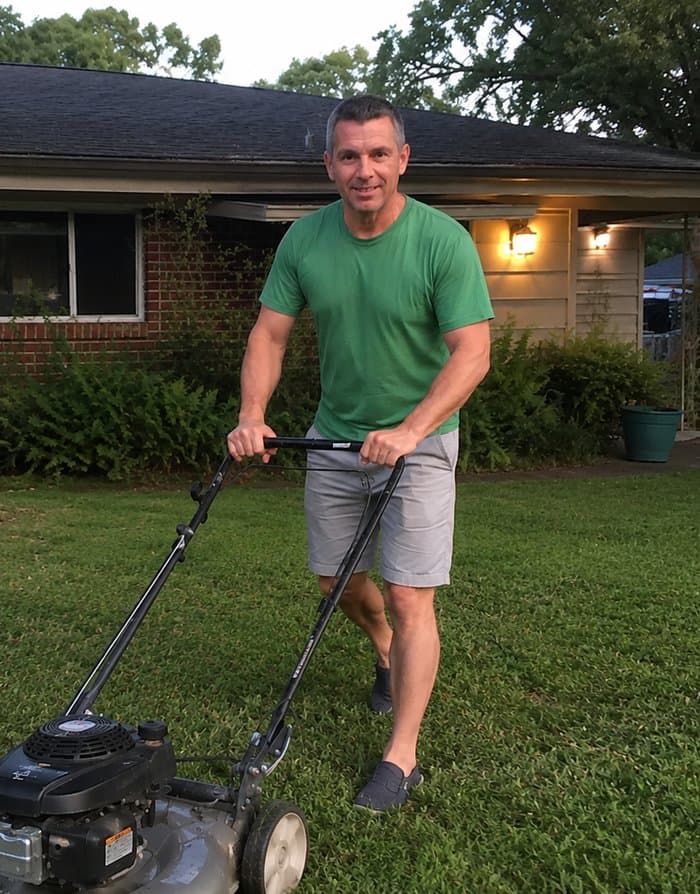
Shot: A homeowner mowing a lawn with a rented core aerator visible parked at the edge.
Alt text: Routine mowing alongside equipment used only occasionally.
A lawn is mostly the product of things done many times. Mowing height, mowing frequency and watering pattern shape it far more than any annual intervention, and those are precisely the jobs a homeowner is best placed to do — you are there every week, and you can act on what the lawn is doing rather than on a service schedule.
1/3
The mowing rule that outranks everything
Never remove more than a third of the blade. Free, weekly, and the biggest single lever.
1–2×
Times a year you core aerate
The classic case for renting or hiring rather than owning.
Free
What a county extension office charges for advice
Worth exhausting before paying for a diagnosis.
Commonly believed
What research shows
The Job-by-Job Verdict
| Job | Verdict | Reasoning |
|---|---|---|
| Mowing | DIY | Weekly, decisive, and entirely about height and blade sharpness |
| Watering | DIY | Needs judgement about conditions, which needs presence |
| Fertilizing | DIY | Rates are arithmetic once you have a soil test. Calibrate the spreader |
| Soil testing | DIY | You collect the sample; the lab does the work. Cheap and decisive |
| Overseeding small areas | DIY | Hand or drop spreader is adequate for patches and thin spots |
| Overseeding a whole lawn | Rent or hire | A slice-seeder gets seed-to-soil contact scattering never will |
| Core aeration | Rent or hire | Heavy machine, once or twice a year, awkward to transport |
| Dethatching | Rent or hire | Same logic, and usually needed less often than people think |
| Weed control by hand | DIY | Selective, immediate, free |
| Broadcast pesticide application | Check the law first | Some jurisdictions restrict this for homeowners as well as companies |
| Irrigation with mains connection | Professional | Backflow prevention and plumbing regulation apply |
| Diagnosing an unidentified problem | Extension first, then professional | Free advice before paid advice |
Where the Law Decides for You
Check your jurisdiction before assuming DIY is an option
If You Do Hire, Ask These
Maryland Extension publishes a set of questions for prospective lawn companies, and they work as a filter because the answers reveal whether a company runs a programme or a calendar:
- How do you prevent or manage weed problems?The emphasis should be on cultural practices that keep turf thick — not a spray schedule.
- At what height will my lawn be mowed? If they mow, this is the most important answer they will give you.
- When would you apply insecticides or fungicides, and which ones? Routine preventative application is a warning sign rather than thoroughness.
- Will you do a soil test? It should be part of any programme, and in some states it is required before phosphorus can be applied at all.
- What fertilizer, how often, and in what amounts? They should know the recommendations for your grass type and keep equipment calibrated to hit the rate.
If you remember five things
- Split on frequency, not difficulty — weekly work is yours, annual equipment work is negotiable.
- Mowing height is the highest-leverage decision on the whole lawn, and no service controls it for you.
- Core aeration and slice-seeding are the two jobs where hiring genuinely competes on cost.
- Check local pesticide rules before assuming an application is yours to make.
- Ask any company whether they soil test. If not, they are guessing at rates on your property.
Common Questions
The Recommendation
Keep the weekly work and buy in the annual equipment jobs. That arrangement gives you control of the things that decide how the lawn looks, avoids owning a machine you would use twice a year, and keeps the cost close to a DIY programme. What a full-service contract mostly buys is time rather than a better lawn.
The exception worth naming: if you genuinely will not mow at the right height or water on the right schedule, a service that does it consistently beats a DIY programme that happens sporadically. Consistency outperforms intention. For what a self-managed programme actually involves, see our annual cost breakdown and weekly checklist.
About the Author
Jack is a lawn care researcher and former landscaping crew lead with 20+ years working transition-zone turf. He writes every guide here from university extension publications and turfgrass research rather than product marketing — after learning the hard way that most of what gets passed around on job sites is backwards.
Have a question or topic suggestion? Get in touch.
Sources and further reading
- University of Maryland Extension — Organic Lawn Care and Supporting Pollinators (questions to ask a lawn care company, applicator registration requirements, local pesticide regulation, and soil testing as part of any programme)
- Ohio State University Extension — Natural Organic Lawn Care (HYG-4031) (core aeration requirements, slice-seeding for seed-to-soil contact, mowing practice, and the one-third rule)
- University of New Hampshire Extension — Organic Turf: Frequently Asked Questions (aeration and overseeding as high-maintenance practices, and fertilizer law applying to any source)
This guide contains no price figures deliberately — service costs vary too much by region and lot size for a national number to mean anything, and extension services publish quantities rather than prices. Licensing and pesticide rules vary by state and municipality; your county extension office is the authority for your area. How we research and review guides is set out in our editorial policy.